In this tutorial, you will learn how to add new language versions to your website, and also find information about the default and primary language of the project. This feature is useful if you need your website in multiple languages.
To use multiple language variants, purchase a Standard, Profi or Business premium plan. The Standard plan offers one additional language version, for a total of two languages on the website. With the Profi and Business plans, the number of language versions is unlimited.
Only the predefined texts in the template are automatically changed in the newly created language version. This allows you to copy the content of your pages but does not serve as a translator of already created texts. For translating texts you can use artificial intelligence — more information can be found in our tutorial How to Translate Texts into Other Languages Using AI.
Adding a New Language
1. To add a new language, click Settings in the editor.

2. In the Languages tab, click Add a new language.

3. Choose a language. Check the Copy all pages and content box to copy all of the site's content. If you do not check this box, only the homepage of the website will be copied; other pages and content can be added manually.

4. You can edit the new language version by switching languages in the top-right corner.

TIP: The language switcher for the public version of the site is displayed at the bottom of the page by default. Alternatively, it is possible to add a language switcher to the additional bar.
5. Publish the changes.
TIP: You can temporarily hide or lock pages that you do not want to publish yet. You can find more information in the articles How to hide a page in the menu and How to Lock a Page.
Default and Primary Languages
Within Webnode projects, a distinction is made between the default and primary language of the project.
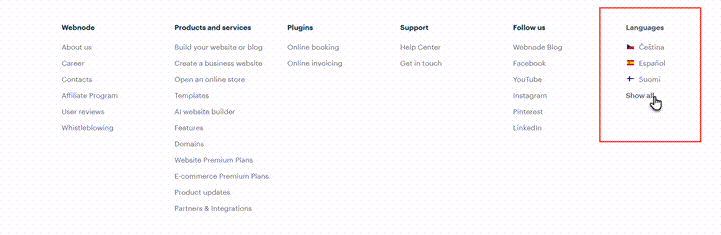
When creating a site, the default language of the project is set according to the language version of the Webnode page on which you are creating the project. So Czech is set via webnode.cz, English via webnode.com and so on. It is not possible to change or remove this language later, so before starting the project, we recommend making sure that you have selected the correct language. You can find the switch at the bottom of the main Webnode homepage.
TIP: If you already have a project set up and wish to have a different default language, you will need to create a new project. You can move any purchased package of premium services to a new project.
The primary language can be set directly in the website editor. Webnode always responds to the browser's default language. For example, if the visitor is using a browser in German, the site will be in German (if German is added as one of the languages). However, if the browser is in Lithuanian (and this language has not been added as one of the languages), the language will default to the primary language of the site. The primary language does not replace the default language of the project, and changing it does not affect the language set when the project was created. You choose the primary language in the language settings: